
Paper and Grain · FIELD NOTE 41
Washi: Handmade Japanese Paper, Fibres, and Community Practice
How is traditional handmade washi made and passed on?
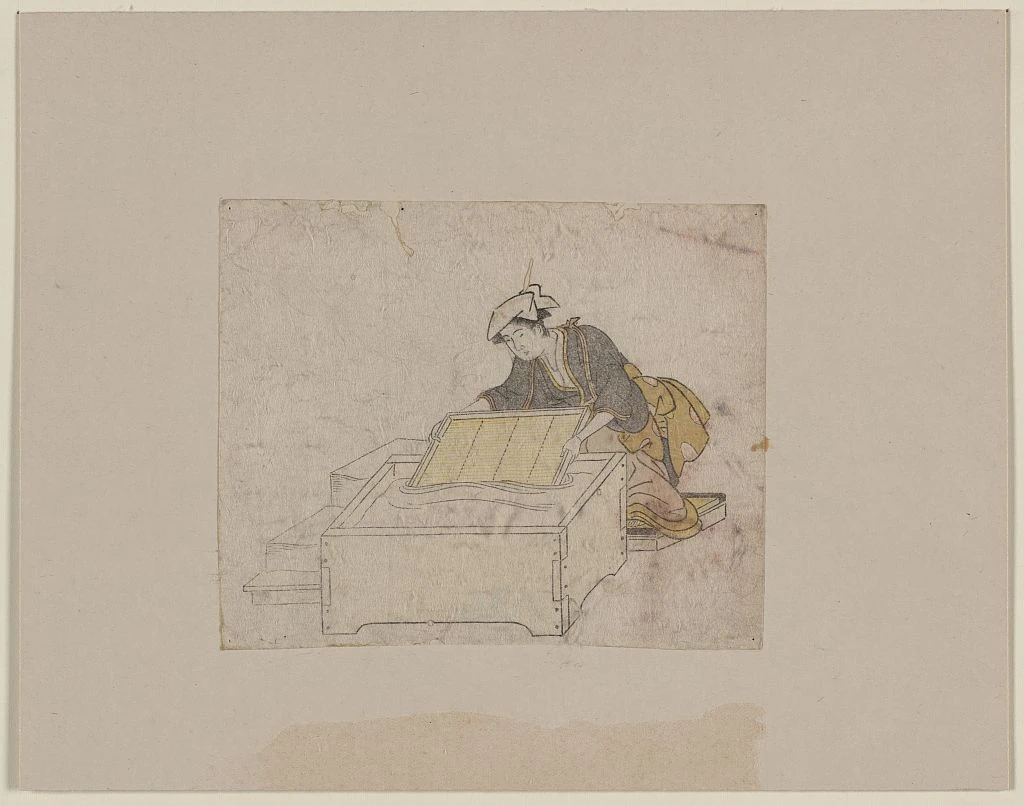
Washi is often introduced as handmade Japanese paper, but the word covers a range of materials and production histories. The International Federation of Library Associations and Institutions notes that washi may be made from kozo, mitsumata, or gampi fibres, with kozo the most commonly used material in the traditional process it describes. The same guide cautions that there is no single clear definition today: paper sold as washi may be handmade or machine-made, and its fibres and processing can vary.[1]
That range matters to readers, makers, and conservators. A sheet’s name does not tell you everything about its fibre source, thickness, surface, strength, or suitability for a particular task. Describing washi well means asking how a specific paper was made and what it is being used for, rather than treating “Japanese paper” as one uniform product.
Fibres and preparation
The IFLA guide describes kozo paper as beginning with the inner bark of the paper mulberry. Bundles of bark are steamed so outer layers can be removed; the white inner bark is then cooked in a mild alkaline solution, cleaned of impurities, and beaten by hand. These are details of the traditional method described by the guide, not a checklist that every contemporary manufacturer follows. Mitsumata and gampi are other named fibre sources, and papers made from them have different characteristics.[2]
After preparation, fibres are dispersed in water. The guide describes using neri, a mucilaginous plant-derived dispersant, to help fibres remain distributed while sheets are formed on a flexible mould using nagashizuki. The sequence shows why the finished paper is connected to water handling, fibre preparation, and the maker’s movements. It does not mean a reader can infer every production step by looking at a single sheet; provenance or maker information is more reliable than appearance alone.
Many places and forms
Washi traditions belong to communities and places, not only to a material recipe. UNESCO’s listing on traditional Japanese handmade paper identifies the craft traditions associated with Sekishu-Banshi, Honmino-shi, and Hosokawa-shi. The IFLA guide describes more than sixty washi-producing areas and notes that production ranges from small hand papermaking workshops to large factories making machine paper. These records show why one regional name should not be generalized to all Japanese paper.[1][2]
Names can refer to a place, a tradition, or a commercial range, and the same word may be used differently by makers and sellers. A label that says “washi” is a useful start, not a full technical specification. When a paper is chosen for conservation, ask the supplier about fibre, formation, additives, thickness, and intended use. A small sample is more informative than assuming that two papers with similar names will behave alike.
How formation affects the sheet
Paper formation gathers fibres into a continuous sheet, and differences in fibre length, dispersion, screen motion, and drainage affect the resulting material. The IFLA guide describes kozo fibres as long and associates them with strong, flexible paper. That does not mean every sheet of kozo paper has the same strength or that longer fibre alone determines performance. Basis weight, formation, surface, sizing, and manufacturing choices also matter.[2]
For a reader handling an existing sheet, observe its scale, opacity, surface texture, and any visible irregularities without flexing it to test strength. Handmade paper may show variations that are part of its formation, while machine-made washi can offer a more regular sheet. Those are broad visual expectations, not identification rules. A close photograph and the maker’s specification are better evidence than a rough test on an important document.
Washi in paper conservation
Japanese paper is used in conservation because particular types can provide thin, strong, flexible support. The IFLA Preservation and Conservation Programme describes uses such as mending a tear, filling a loss, reattaching a page as a hinge, or lining a sheet. It also notes that conservators select a paper whose thickness, flexibility, colour, texture, and quality suit the object. “Washi” alone is not enough information to choose a repair material.[2]
The same guide describes wheat starch paste as a commonly recommended adhesive in this work and says training is important before using the technique on library materials. Its discussion is professional guidance, not a do-it-yourself recipe for a rare book. Adding moisture, paste, and a new support can change an object permanently if the material or method is mismatched. For an important, brittle, or already damaged document, leave repair to a trained conservator.
Community knowledge and continuity
Traditional craft knowledge includes coordinated skills that are not captured by naming a plant fibre. Preparing bark, sorting fibres, managing a vat, forming a sheet, and drying it all require practical knowledge. UNESCO’s heritage listing documents named traditions, while IFLA’s overview describes variation among regional practices and production facilities. Together these sources encourage attention to makers and communities rather than presenting washi as an anonymous commodity.[1][2]
Descriptions should be specific about what is known. If a museum record identifies a paper by region or tradition, preserve that wording and link the record. If a supplier only labels a pack “Japanese paper,” do not add a village, lineage, or handmade claim without evidence. Cultural and material accuracy are connected: a broad label can erase the differences that make a tradition meaningful.
Choosing and storing paper
For craft work, select paper for the task: folding, printmaking, drawing, or a conservation exercise may require different weights and surfaces. For collection repair, seek professional specifications and use practice materials to learn. Store unused sheets flat or rolled only as the supplier recommends, protected from dust, light, and damp. Keep samples labelled with maker, product description, dimensions, and date received so that future users can identify them.
For an existing washi document or mounted object, follow the holding institution’s handling instructions. Avoid rubbing the surface, wetting a stain, or lifting a corner to see what lies beneath. Thin paper may be strong along one direction and vulnerable at a fold or attachment. Support the full sheet when moving it, and ask a conservator about tears, creases, or active media loss.
A precise way to talk about washi
Washi joins fibre knowledge, forming technique, regional practice, and contemporary manufacturing. The IFLA guide is explicit that usage has broadened and the term does not guarantee one production method. UNESCO’s heritage record focuses on named craft traditions. Together they provide a factual basis for appreciating the diversity without reducing it to a single story.[1][2]
When describing a sheet, record the name supplied by its maker or collection, state whether its production method is documented, and note its visible form separately from what you infer. That modest discipline gives the paper’s maker and history room to remain specific. It also helps readers select materials with care and avoid treating a cultural tradition as a generic texture.
Sources
References below support the factual explanations in this article. Read each source within its stated scope and context.