
Tool Bench · FIELD NOTE 24
The Book Press: Pressure, Time, and Flatness
What is a book press for?
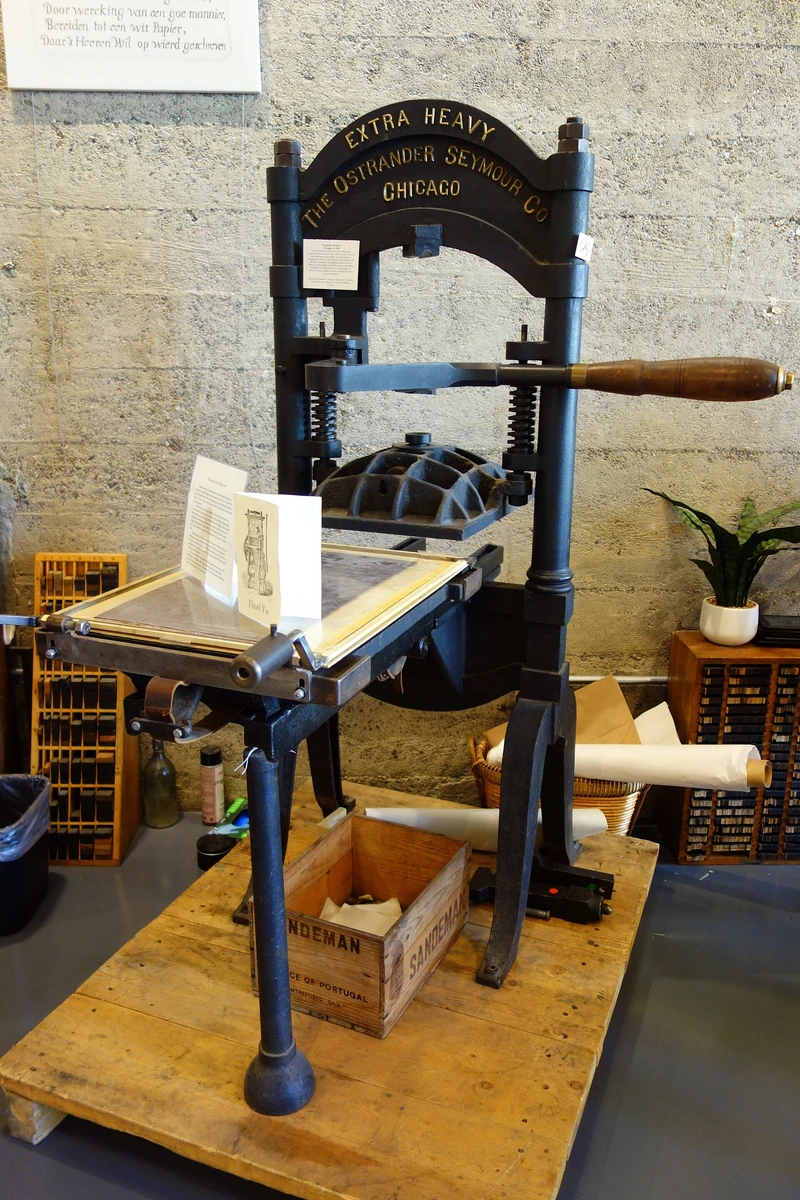
A book press can hold a planned assembly while a process takes place. It cannot determine which process the object needs. That distinction matters when a maker wants a newly pasted cover to dry evenly and when an owner sees a wavy old page and reaches for weight. The first situation may belong to a known construction method. The second begins with an unexplained condition. Before applying pressure, identify the materials, the purpose, and what must be allowed to move or dry.
Different presses do different jobs
Roberts and Etherington describe a nipping press as a screw-operated tool for quick, uniform pressure and distinguish it from other press forms. The visible silhouette of an old cast-iron machine does not establish its precise function or present safety. Equipment must be sound, stable, and suitable for the task. Follow its operating instructions and keep fingers clear of closing surfaces. A decorative antique should not be assumed ready for workshop use merely because its screw turns. [1]
Pressure and support are separate decisions. A platen can move downward while an uneven stack concentrates contact on only part of the object. A projecting clasp, raised decoration, loose fragment, or thick insert can change what receives the load. Do not assume that a flat plate creates a uniformly protected object beneath it. The arrangement of support and any protective layers needs to belong to a complete, appropriate method.
Write the intended result first
For new work, describe the goal in plain language before assembling the press stack. Perhaps a known procedure calls for holding an adhesive connection aligned as it dries. That is more informative than pressing the book flat. It identifies both the connection and the process. It also creates a stopping question: what evidence will show that the assembly is ready to leave the press, and does the selected method explain the drying arrangement?
Dartmouth's repair manual includes press boards, weights, and a book press within particular repair sequences. Their roles come from those sequences; they are not interchangeable commands to flatten any damaged volume. A timing instruction for one adhesive, material stack, and operation should remain attached to that context. Copying its duration while changing the object and adhesive can leave the most important drying conditions unexamined. [2]
A sample should include the hidden layers
Build a representative expendable assembly before committing valuable new materials. Include the actual covering, board, adhesive method, and separating layers proposed for the project. A clean-looking top surface does not show what happened inside. After normal drying, inspect alignment, surface change, sticking, and the movement needed in the completed structure. This is a suggested rehearsal, not a reported test of any particular pressure, duration, or press model.
Keep the sample result with a short record of the stack order. A photograph or sketch can identify which side faced a board and where separation material was placed. If an unwanted impression appears, change one relevant element and try again on expendable stock. Without that record, repeating the operation may reproduce the mark without revealing its source. The value of a press is controlled repeatability, not simply the ability to apply a large force.
Flatness can hide a different problem
A distorted page might reflect moisture history, attached material, an uneven binding, or another cause. Pressing it does not identify which explanation applies. Nor does temporary flatness demonstrate that the underlying condition is resolved. In a historic object, the distortion itself may carry evidence of use or manufacture. A treatment decision should consider significance and media as well as the owner's preference for a more regular outline.
Think of a hypothetical album whose pages contain photographs of different thicknesses. Compressing the closed volume treats its unevenness as an error without considering the attachments. Another book may have raised cover decoration that receives the load before the boards do. These examples show why support must follow the object. They are not prescriptions for making custom press stacks around fragile originals; that work can require professional examination.
Moisture and weight are not a household repair recipe
Do not dampen old leaves and place them beneath heavy books in an attempt to reset their shape. Water-sensitive media, adhesives, coated papers, and previous repairs can respond differently. The Canadian Conservation Institute discusses paper objects as combinations of support and media with distinct vulnerabilities. A flattened sheet can still have suffered altered colour, transferred writing, or a changed surface. Appearance after pressing is an incomplete measure of treatment success. [3]
If a book is wet from an incident, treat it as a salvage problem requiring appropriate guidance, not as a routine pressing exercise. If it is dry but warped, document its present condition and ask whether access actually requires flattening. A suitable support, adjusted storage, or a surrogate may solve the immediate use problem while leaving treatment for a conservator. A press should not become the default destination for everything that looks uneven.
Responsible pressing begins with a known task and a controlled assembly. Use appropriate equipment, rehearse the complete material stack, and record what the operation is supposed to achieve. For collection objects, establish the cause and significance of distortion before trying to remove it. Pressure is an available workshop resource, not an explanation. It becomes useful when purpose, support, and material response are understood well enough to justify its application.
Sources
References below support the factual explanations in this article. Read each source within its stated scope and context.