
Binding Structures · FIELD NOTE 03
Sewing Supports and the Work They Do
Why do some old books have cords or tapes across the spine?
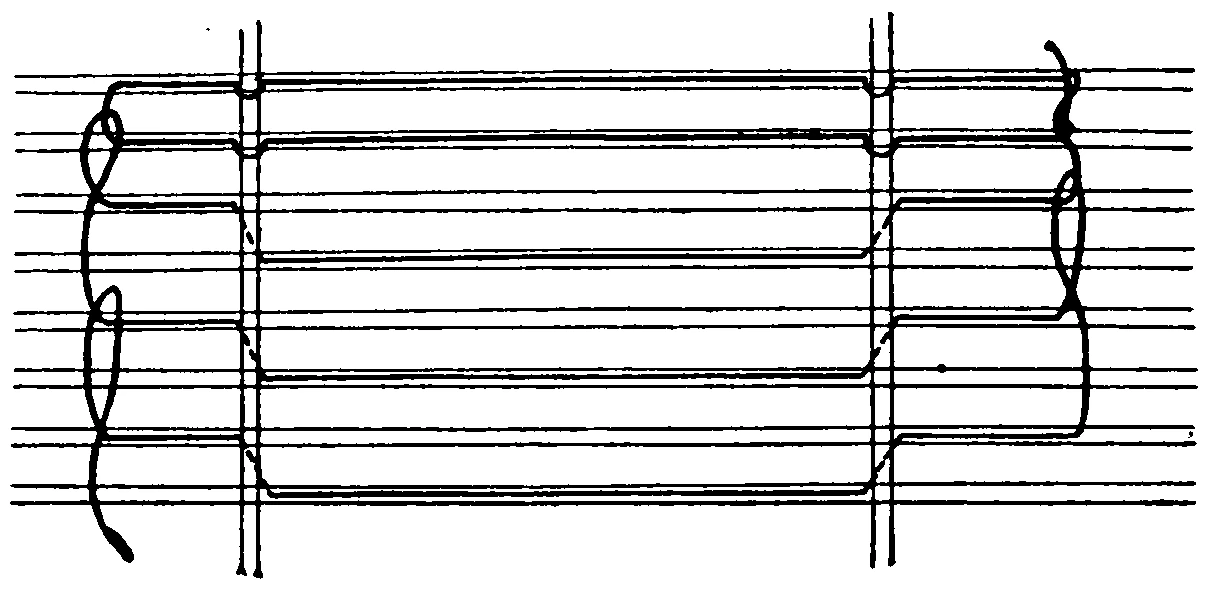
A cord crossing the back of a book is not simply a raised decoration. In a supported sewing structure, the sewing connects folded sections with another material that helps organize their attachment. Yet not every raised band conceals a functional cord, and not every book needs the same kind of support. The useful task is to distinguish what can be observed about the thread path, the supporting material, and its relationship to the boards before drawing conclusions about strength or construction.
Thread and support are different components
Think of the sewing thread as the moving route and a cord or tape as something that route engages. A drawing with one line for the thread and a different shape for the support can clarify the distinction. This is a teaching device rather than a reconstruction of an unseen spine. The route may pass around a support, through another component, or between sections without separate supports, depending on the binding under examination.
The Language of Bindings notes that sewing stations also occur in unsupported structures and that a broad support can correspond to a station with more than one hole. Counting holes, stations, and supports as though they were interchangeable therefore produces a misleading description. Record each count only when the relevant feature can actually be seen. A pair of holes at one working position need not mean that two separate supports were used. [1]
A flat tape and a round cord invite different questions
Flat and rounded supports occupy space differently. For an observer, that difference changes what to look for: the width of contact, the route of thread, and whether the support continues toward a board. It does not establish which material is universally stronger. The integrity of the paper, thread, attachment, and previous treatment all affect the useful performance of a particular structure. A thick cord in a damaged volume is not a strength certificate.
A treatment account from the National Records of Scotland illustrates why a single simple diagram is insufficient for all historic books. Its described volume includes primary and secondary supports and a particular board-attachment arrangement. That documented object is evidence of structural variety, not a standard to impose on every binding. When a book does not match an introductory illustration, investigate the difference rather than immediately calling it incorrect or later repaired. [2]
Read a visible band cautiously
The outside of a covered spine gives indirect evidence. A raised ridge may correspond to a support, but it can also belong to decorative construction. Conversely, a smooth-looking spine does not demonstrate the absence of sewing supports. The responsible description of an unexamined cover might be raised bands visible, with the underlying attachment not established. That wording protects the distinction between appearance and structure while still giving a reader useful descriptive information.
Suppose a hypothetical book has five exterior bands but only three positions where its sewing can be observed safely. Do not complete the pattern by assumption. Record the five exterior features and the three visible sewing positions separately. A later examination may connect them, distinguish false bands, or reveal repairs. Your original note remains useful because it preserves the limits of the evidence instead of converting an expectation into a supposed observation.
Where a support meets the cover
Follow the relationship toward the boards only where it is already exposed. A support may participate in board attachment, and its surviving end can help explain how the cover was held. Do not pull a projecting cord or lift an endpaper to discover its route. The point of structural literacy is to reduce unnecessary disturbance, not to justify dismantling layers until every component in a diagram has been located.
A simple observational comparison is more helpful than a strength test. Ask whether one board appears disconnected while the sections remain grouped, or whether the grouping itself is unstable. Those conditions suggest different areas for professional examination. They do not establish that cutting a support, adding another one, or replacing thread will solve the problem. Repairs can change how opening forces are shared, so a decision about one component must consider the complete assembly.
What a useful sewing note includes
Describe the visible material without claiming fibre identification from colour alone. Record whether it appears flat or round, its location along the spine, its visible route, and any exposed breaks. If old and new thread coexist, describe the difference rather than assigning dates without evidence. A labelled sketch can show which route was observed and which remains hidden; dashed lines should mean conjecture, with that convention stated beside the drawing.
For a maker working on a new model, identify the intended attachment before choosing a support merely for its appearance. A decorative exposed spine and a covered binding present different design constraints. Build a sample with expendable paper and evaluate the planned movement before committing important content. This is a proposed learning method, not a claim that a particular support dimension or sewing recipe has been tested here.
Sewing supports matter because they connect otherwise separate decisions: how gatherings are held, how a spine moves, and how boards remain associated with the text. Learning to distinguish a band, a station, a hole, and a support makes those connections legible. It also supplies a clear stopping point: when the next answer would require pulling, opening, or removing material, preserve the observation and let an appropriately trained examiner continue.
Sources
References below support the factual explanations in this article. Read each source within its stated scope and context.