
Binding Structures · FIELD NOTE 10
Spine Linings: Layers That Shape a Book's Motion
What sits under a book's spine covering?
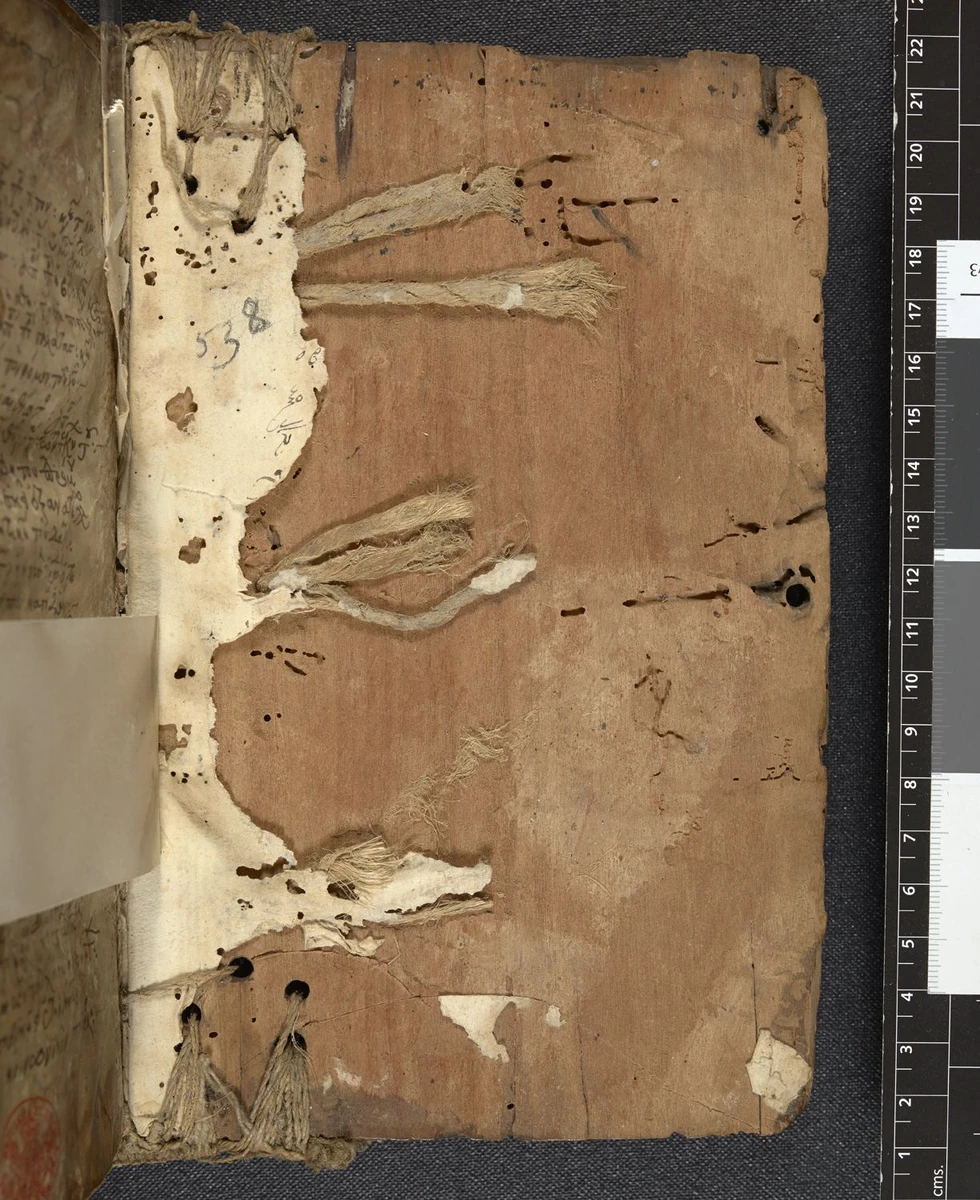
The surface visible behind a book's title is not the whole spine. Between a text block and its covering there may be layers that reinforce, connect, separate, or control movement. These linings can be hidden until damage exposes them, which makes it tempting to dismiss a loose strip as waste or to cover it with fresh adhesive. A better starting point is to ask what each layer touches and how that relationship changes when the book opens.
A moving cross-section
Draw a closed book from the head, with two boards beside the text block. Now sketch a partly open version. The drawing invites a useful question: must every layer follow the same curve? Different constructions answer differently. Some connections keep a covering close to the spine; others allow a separation. A layer that looks detached in one simplified diagram may be doing exactly the separating job intended in another arrangement.
Tom Conroy's study of spine movement distinguishes the structure at rest from the action of opening and examines how linings, sewing, and joints interact. It is a specialist mechanical discussion with stated assumptions, not a universal diagnostic chart. Its most useful introductory lesson is to consider relationships between components. A material cannot be judged suitable solely because it is strong when pulled independently of the book in which it will work. [1]
Reinforcement has a direction
A lining may extend across the spine and toward a board, while another layer may occupy only the spine area. Their different extents suggest different tasks, but an ordinary exposed edge may not reveal the complete attachment. Describe visible width, location, and direction before naming a function. A cloth-like surface is not sufficient evidence for a particular fibre, manufacturer, or original date. Earlier repairs can introduce materials that resemble one another at a glance.
Think of a hypothetical reinforcing strip that is much stiffer than its neighbors. Strengthening one region can alter where movement occurs. That is a mechanical reason to be cautious about a thick repair, not a prediction that every stiff layer will fail. The useful comparison asks whether the whole book can still move as intended. A stronger patch on one spot is not automatically a stronger or more usable binding overall.
An intentional hollow is not an empty repair site
In the Salzinnes Antiphonal treatment, the Canadian Conservation Institute describes a hollow arrangement that permits opening without requiring the covering leather to follow the spine directly. The documentation explains the intervention in relation to that particular manuscript and its existing materials. It provides a concrete example of purposeful separation. It does not mean that every gap should be enlarged, every tight back converted, or every hollow constructed with the same materials. [2]
For a reader, this distinction has a direct consequence: do not fill a visible spine gap with glue merely because the space looks unfinished. Determine whether there is actual loss of attachment elsewhere. A board hanging free and an intentional hollow are different observations, even if both expose a space near the spine. A conservator needs information about the joints and text block, not just a photograph of an opening that looks unfamiliar.
Treatment layers can be designed for later treatment
The same CCI account describes a protective paper layer and additional support materials in its chosen reconstruction. Its explanation connects the sequence of layers with later removal and board attachment. This is a reminder that a lining decision concerns the next treatment as well as today's result. A hidden layer can either help future separation or make that work more difficult; invisibility does not make its consequences unimportant. [2]
In a new teaching model, label each layer on the plan before applying it. Give it an intended task, such as temporary separation, attachment, or reinforcement, and explain what it connects. If two layers have no distinguishable purpose, reconsider the design before adding thickness. This is a proposed design discipline, not a conservation recipe. The actual material and adhesive must still be appropriate to the object and to a complete, reliable construction method.
When damage reveals the inside
If an old lining becomes visible through a split cover, photograph it in context without lifting it further. Note which side of the spine it appears on and whether the text block remains secure. Keep detached fragments labelled with the volume. Do not discard a printed scrap because it seems unrelated to the book's contents; reused material can carry evidence about binding history, though identifying that evidence may require specialist study.
Access can often be adjusted before treatment is decided. Reduce the demanded opening, support loose boards, or consult another copy for the immediate reading task. These choices do not repair a failed attachment, but they can avoid further movement while the structure is assessed. A condition note should say what can currently be done safely rather than promising that a particular glue or fabric will restore the volume to unrestricted use.
Spine linings are best understood as a sequence of connections with different jobs. Ask what touches the text block, what joins a board, what separates a covering, and what moves during use. Those questions turn a hidden mass of cloth, paper, and adhesive into a readable mechanical arrangement. They also establish why a small exposed gap can deserve careful description instead of an immediate attempt to make every layer stick together.
Sources
References below support the factual explanations in this article. Read each source within its stated scope and context.