
Binding Structures · FIELD NOTE 04
Coptic Chain Stitch: What the Exposed Pattern Reveals
What makes a Coptic-bound book open so freely?
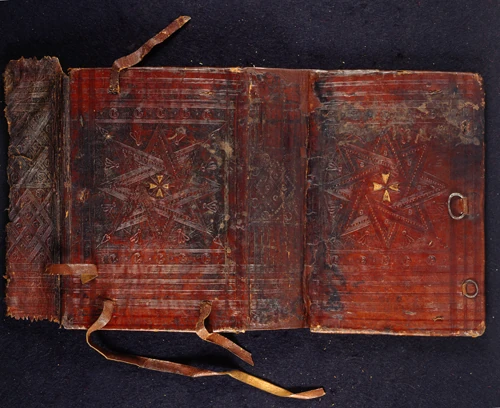
An exposed chain of stitches makes a handmade book unusually easy to study. You can see one gathering connect to another instead of looking at a covered spine and guessing. The visible pattern is also easy to overinterpret. A modern journal described as Coptic is not automatically a replica of a historical binding, and a book that opens readily is not guaranteed to remain safe at every opening angle. The thread pattern is the beginning of the explanation, not the whole specification.
Historical name, modern shorthand
Roberts and Etherington describe historical Coptic bindings as a family associated with Egyptian Christians, including chain-like sewing links and covers frequently joined through sewn or laced loops. Their account also includes covering and lining features that are absent from many present-day exposed-spine journals. This is a useful correction to the idea that a bare spine and two boards reproduce a single timeless historical design. Modern teaching labels simplify a more varied material record. [1]
When describing a contemporary book, distinguish the maker's chosen label from what you can see: linked sewing between gatherings, exposed thread across the spine, and the particular cover attachment. Those observations do not require a claim about the object's age or cultural origin. A historical attribution needs contextual research, whereas a structural description can remain accurate even when the name on a workshop handout is broad or used differently by another instructor.
Follow one link before counting the pattern
On a new, expendable model, trace the route from one section to the next with your eyes. Where does thread leave the fold, engage a preceding link, and return? Use a separate drawing rather than catching a real thread with a needle. Different colours on the drawing can represent successive gatherings. The exercise makes the sequence comprehensible without treating the chain as a piece of embroidery attached after the book was assembled.
A useful distinction comes from the Language of Bindings: a sewing station remains a station even in an unsupported structure. An exposed row of links is therefore not proof that the book has cords hidden beneath it. Thread-to-thread connections and sewing over independent supports are different arrangements. Count what is visible and name the method cautiously; a regular exterior rhythm alone cannot reveal every passage inside a section. [2]
Why opening feels different
A contemporary exposed-spine model may let successive gatherings articulate without a continuous covering pulling across the outside. That observation helps explain a broad opening, but the actual movement depends on paper, sewing tension, section thickness, and board attachment. Avoid making lay-flat a universal promise. A photograph showing one well-behaved opening does not demonstrate how the first gathering, last gathering, or a heavily decorated page will behave during ordinary use.
Imagine two hypothetical journals with similar chain patterns. One contains thin, flexible sections; the other has thick pages carrying added collage. Their outward stitch rhythm may look alike while the demands on the folds differ considerably. This comparison is design reasoning, not a report of comparative testing. It shows why selecting a binding by a picture of its spine can overlook the content the finished object will actually need to carry.
The cover connection deserves its own inspection
A stiff board and a flexible gathering meet at a transition that sees repeated movement. Observe the first and last connections separately from the attractive links in the middle. If a board appears to hang away, do not tighten a nearby loop simply to improve its alignment. A change in tension at the end may alter how the neighboring paper is loaded. What looks like a loose stitch may require examination of the entire cover attachment.
For a new project, decide the intended page format and board size before copying a decorative sequence. Place the planned book beside a paper model of its opening envelope: how much desk space will it need, and where will the boards rest? These questions connect design to use. They are more informative than assuming that adding another row of chain stitches will make an otherwise unsuitable book work well.
Exposed does not mean maintenance-free
The very feature that makes the structure easy to read also leaves thread accessible to rubbing and catching. A protruding stitch should not become a handle, bookmark anchor, or place to attach an ornament without considering its structural role. Store a vulnerable model so adjacent objects do not drag across the spine. If an enclosure is needed, it should allow removal without scraping the links or squeezing the boards out of alignment.
For an existing collection object, do not add adhesive along an exposed spine as an automatic reinforcement. That would change a moving connection into a different system and could conceal evidence. Keep any detached fragments associated with the volume and document the visible break. A conservator can assess whether the present structure, later changes, and access needs justify treatment; familiarity with a workshop version is not equivalent to identifying the historical object.
Coptic chain stitch offers an unusually direct lesson in how a book is joined. Read the sequence of links, distinguish the sewing from the cover connection, and consider the content before admiring the opening angle. The result is a more precise description and a better design conversation. Historical names become useful when their limits are acknowledged, and visible craftsmanship becomes understandable through its relationships rather than through a promise of effortless opening.
Sources
References below support the factual explanations in this article. Read each source within its stated scope and context.