
Binding Structures · FIELD NOTE 07
Japanese Stab Bindings and the Limits of Opening
Why do Japanese stab-bound books open differently?
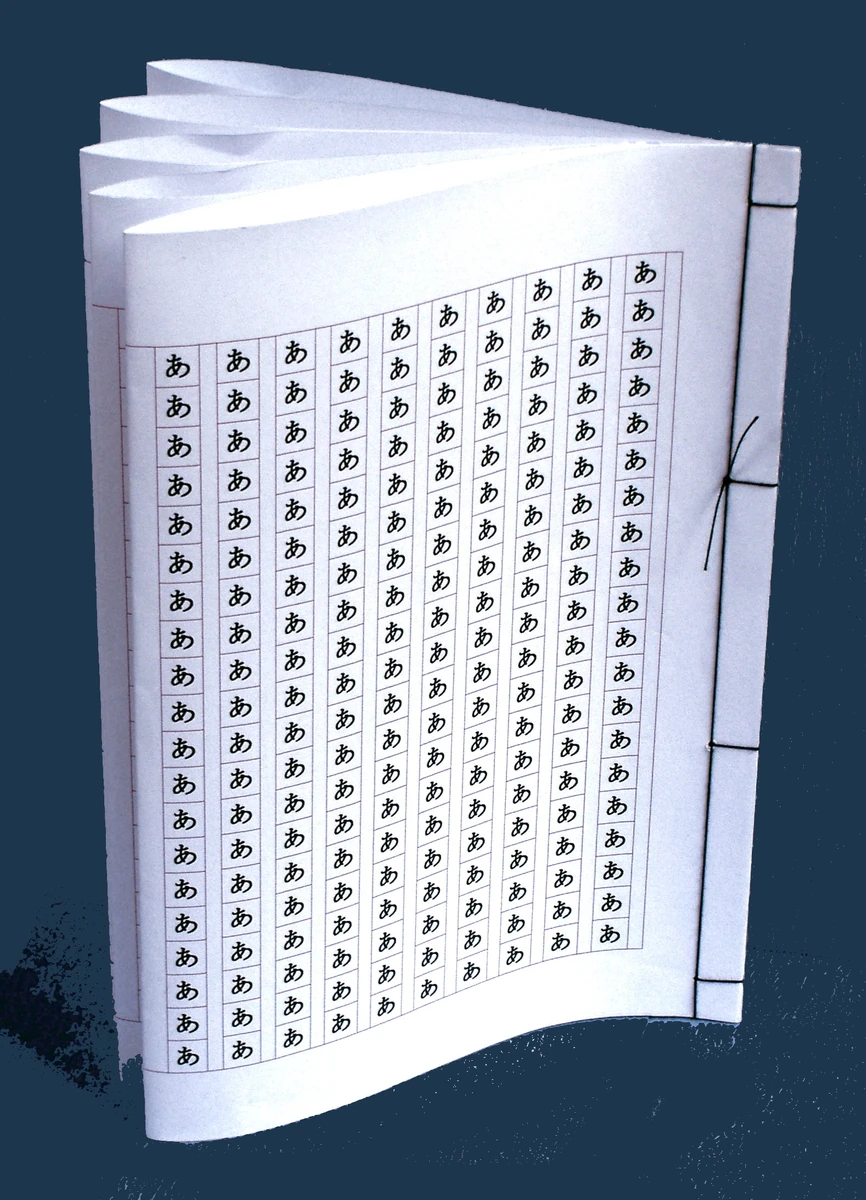
A Japanese stab-bound book asks the page to turn beside the sewing, rather than around a sewn central fold. That difference explains both its distinctive edge pattern and the space it needs near the gutter. Before calling an opening stiff or defective, look at how the leaves are attached. A binding can be working as intended while refusing to behave like a modern notebook. The reader's task is to accommodate that construction, while the maker's task is to plan content around it.
The folded edge may be opposite the sewing
In fukuro toji, or pouch binding, the folded sheets are arranged with their folds at the fore-edge. The National Diet Library's four-hole binding manual explains this construction and its yotsume toji form. This is an important reversal for a reader accustomed to folded gatherings sewn at the spine. The visible fold at the outside edge is not an unopened section waiting for a knife. Cutting it would alter the leaf and could damage the book. [1]
Stab binding is a broad descriptive family, so do not assume every object bearing that label contains identical folded sheets or follows one decorative pattern. A contemporary artist may use individual leaves, a different cover, or a modified route. Describe whether the observed leaves are folded and where those folds occur. Cultural and historical identification needs more evidence than a thread pattern copied from a familiar introductory project.
Reserve a binding margin in a new project
A hole through the side of a stack takes usable width from the page near the sewn edge. Content positioned as though the entire sheet were freely available can disappear into that margin. Before printing, make a dummy at the proposed size and mark a line representing the attachment zone. Place sample text and a picture near it. The exercise reveals a layout constraint without needing a rule copied from a differently proportioned book.
Compare the same page design in a fold-sewn dummy and a side-sewn dummy. Their pages may share dimensions while offering different comfortable reading areas. This is a suggested design comparison, not a report of a test performed here. It helps explain why replacing one binding method with another can require new margins and page composition. A visual treatment that works beautifully on the outside may still be unsuitable for an image intended to span an opening.
Opening is a relationship, not a target angle
The University of Kansas's four-hole model describes lightweight folded paper and the fore-edge arrangement. Its value is a clearly identified example, not a promise about every book in the category. For an existing object, support the leaves and covers where they naturally rest. Do not press a stiff page down to obtain a symmetrical spread. The absence of a flat opening is not, on its own, a reason to resew or replace the cover. [2]
If a camera cannot see the innermost text, change the photography plan before changing the book. A different camera position, separate images, or consultation with collection staff may be appropriate. The aim is legible documentation with the least necessary movement. A perfectly rectangular photograph is a property of the image, while a strained sewing margin is a change to the object. Those outcomes should not be traded as though they were equally reversible.
A pattern must still preserve paper
For a new model, establish the full stack thickness and grain behavior before transferring a hole diagram. Use an appropriate manual to select the complete method, including cover preparation and thread route. Support the work and keep hands out of the piercing path. Making a familiar decorative pattern more elaborate does not automatically make it stronger; additional openings also change the material that remains around the sewing zone.
Thread should secure the stack without becoming a cutting edge against damaged paper. If the dummy puckers, holes enlarge, or pages resist ordinary turning, reconsider the materials and layout instead of simply pulling harder. The correct response may be a thinner stack, a different paper, or a different binding form. It is better to change a prototype than to force a sentimental manuscript into the limitations of the first method learned.
Handle the book as a complete unit
The National Diet Library also publishes guidance specifically for handling Japanese-bound books and Chinese classics. Its existence is a reminder that format-specific handling matters; generic advice based on a Western hardback may overlook differences in covers, leaf construction, and storage. Follow the holding institution's current instructions, especially when wrappers, fastenings, or associated protective cases form part of the item being consulted. [3]
Do not lift a vulnerable book by its sewing, tug a projecting thread end, or insert a thick bookmark that pushes the leaves apart. When recording damage, identify the particular position: thread broken near the head, torn paper around a station, or a detached cover edge. These descriptions are more useful than saying the binding is tight or loose, because they identify what is actually changing and where support is needed.
Understanding the sewn margin changes both making and reading. A maker can reserve enough space for content and rehearse the page turn before committing a final edition. A reader can recognize the fore-edge fold and work with a supported opening. The result respects the binding's logic without turning one historical format into a universal craft recipe or treating every difference from a lay-flat notebook as a flaw.
Sources
References below support the factual explanations in this article. Read each source within its stated scope and context.