
Binding Structures · FIELD NOTE 08
Endpapers: The Quiet Bridge Between Board and Text
What are endpapers for besides decoration?
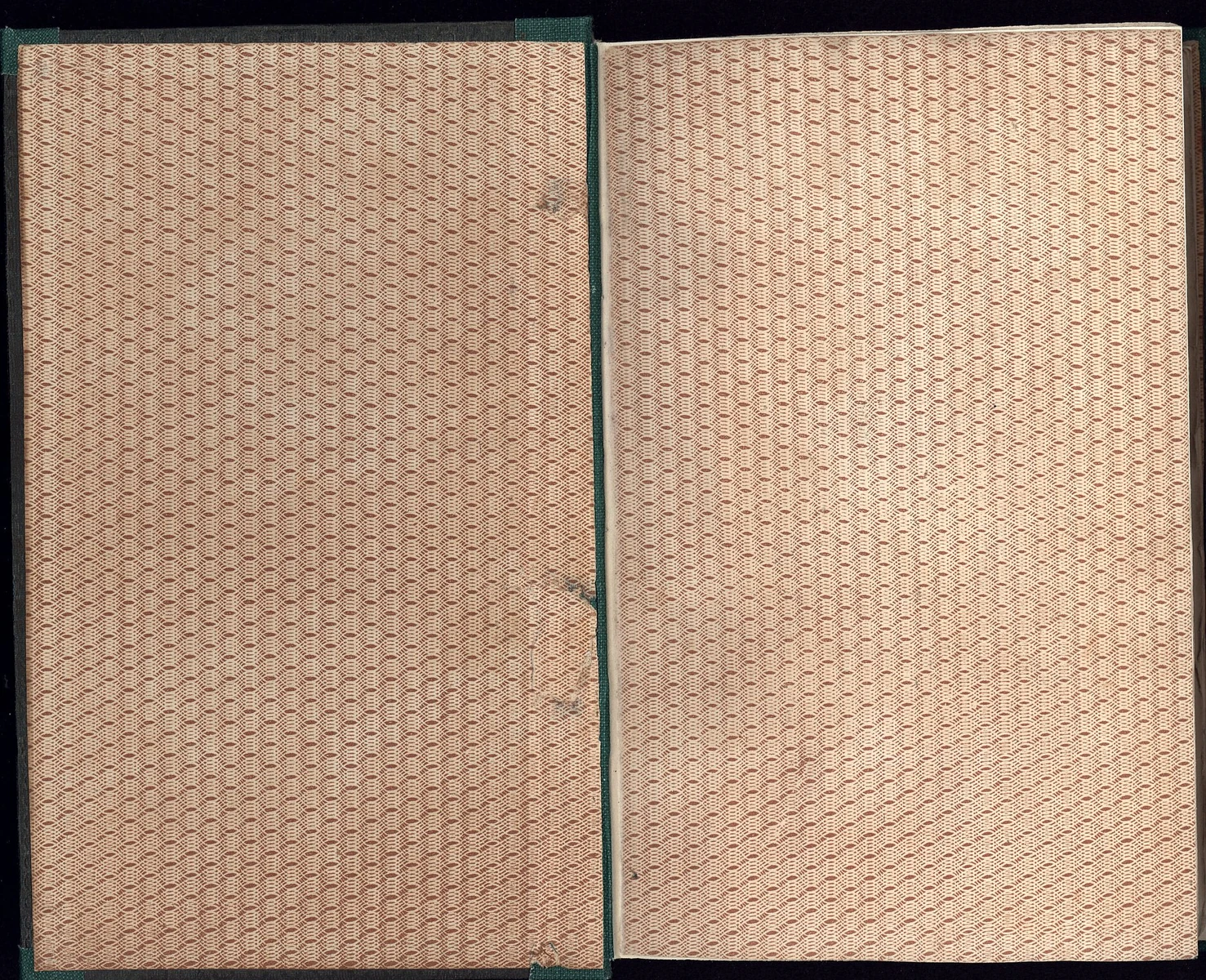
The first decorative opening in a hardback can conceal one of its most important transitions. Endpapers occupy the space between cover and text, but they are not simply blank pages added for appearance. To read them well, ask which leaf is fixed, which turns freely, and how the assembly meets the first or last section. These questions help distinguish a damaged attachment from an intentionally different paper and reveal why replacing an endpaper can remove evidence as well as material.
The fixed leaf and the turning leaf
The pastedown is attached to the inside of a board. A free endleaf, often called a flyleaf, turns separately. Roberts and Etherington describe endpapers as units that may include several leaves and explain their protective and structural functions. The arrangement is therefore more varied than a single folded sheet in every book. When describing a volume, identify what is actually present rather than filling in a familiar construction from memory. [1]
A simple new-book model makes the transition easier to understand. Draw a rectangle for the board and another for the text block, then place a folded paper bridge between them. Mark one side fixed and the other free. This diagram is deliberately incomplete: real endpaper systems can be sewn, reinforced, tipped, or otherwise constructed. Its purpose is to separate the role of a visible surface from the route through which movement reaches the next component.
Decoration does not cancel function
A map, marbled design, or publisher's illustration can make the first opening seem like a self-contained artwork. Examine its relationship to the inner edge before thinking about cleaning or replacement. If the paper splits there, the problem is not adequately described as a stained decorative page. If the design continues across the opening, record the two halves together so the visual relationship remains understandable even when a handling limitation prevents a full photograph.
Endpapers also carry traces of ownership and trade. The University of Toronto's exhibition documents inscriptions, bookplates, labels, stamps, and tickets on these surfaces. A clean replacement sheet would not preserve those relationships merely because someone photographed one label first. The paper, placement, overlaps, and association with other marks may contribute information. This is why improving the appearance of a marked endpaper and preserving its documentary value can be different goals. [2]
A lifted corner is not a starting handle
If a pastedown has lifted, do not pull it back to inspect the board. The underside can include earlier repairs, covering turn-ins, or reused material, but uncovering it is an intervention. Note where the lifting occurs and whether the paper carries information. A conservator can decide whether examination or treatment is justified. Curiosity about a hidden layer does not establish that lifting the whole sheet will be safe or useful.
Consider two hypothetical front openings. One has a torn free endleaf but a sound joint; the other has an intact leaf with a split where it meets the board. The first may mainly limit protection of the first printed page. The second may affect the transition between cover and text. These examples are not diagnoses, but they show why the phrase damaged endpaper is too broad to determine a repair. Location and attachment belong in the description.
Replacement materials must belong to the structure
For a new binding, an appealing decorative sheet must also suit its intended role. Ask whether it folds comfortably, whether its grain has been considered, and whether its thickness fits the opening. A heavy artist's paper and a thin printed map may be attractive for different reasons yet create different transitions. Use a mock-up with the proposed cover and first section rather than approving the sheet only as a flat colour sample.
For a historic volume, replacing an endpaper is not merely selecting a prettier paper. Canadian Conservation Institute documentation of the Salzinnes Antiphonal describes new endpapers chosen in relation to surviving evidence and board attachment. That is a specific treatment, not a general recipe. It illustrates the kind of reasoning that is missing when an endpaper is treated as disposable decoration: material choice, surviving fragments, structure, and future access are considered together. [3]
Describe the opening in layers
A practical record can identify the front pastedown, free endleaf, joint, first text leaf, and any visible reinforcement. Locate writing or labels independently of damage: an inscription on a free leaf is not on the board, and a bookplate over a pastedown may obscure an earlier mark. If you cannot see whether a leaf is sewn or merely tipped, say so. The limit is useful information for the next examiner.
When reading, support a loose board so it does not hang from the paper connection. Do not flatten a reluctant opening to capture the whole decorative spread. If the immediate task is to transcribe an inscription, a partial view or separate images may suffice. This keeps the research question in proportion: obtaining the text does not necessarily require revealing every hidden attachment or making the opening symmetrical for a photograph.
Endpapers link three kinds of evidence: the mechanics of the opening, the protection of the text, and the history carried by marks and decoration. Their value is clearest when those roles are examined together. Name the fixed and free parts, describe damage by position, and consider what replacement would erase. That approach produces a better account of the book and a more informed decision about whether anything needs to change.
Sources
References below support the factual explanations in this article. Read each source within its stated scope and context.