
Binding Structures · FIELD NOTE 09
Headbands: Structure, Signal, and Edge Protection
Are headbands functional or only decorative?
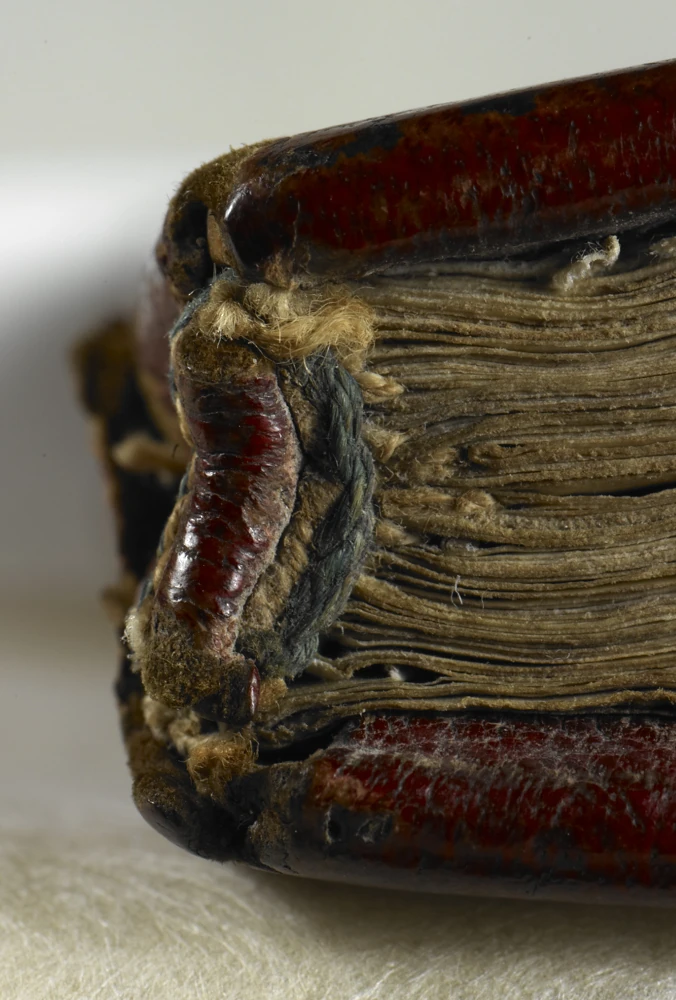
A narrow coloured band at the top of a spine can look like a small finishing flourish. In one book it may be attached only with adhesive; in another it may belong to a sewn structure linking sections and even boards. The practical question is not whether headbands are always decorative or always functional. It is what this particular band is connected to. That question changes how the feature should be described, handled, and considered during treatment.
Head, tail, and the term endband
Head names the upper edge of the book and tail the lower. Endband is a useful collective term for features at either end, although headband remains common in everyday speech. A description should state the actual position rather than relying on the term alone. If only the upper band survives, say that. Absence at the tail does not automatically demonstrate loss; the history and construction may require closer examination before a missing component can be inferred.
Mark Furness's account of French MS 62 at the John Rylands Library explains the difference between sewn and stuck-on endbands and discusses the structural contribution some historical examples make. It also describes the difficulty of treating a detached band in that manuscript. The account is valuable precisely because it concerns a specific object: it does not turn a familiar coloured strip on a modern hardback into evidence of an identical historical attachment. [1]
Look for attachment, not just a stripe
A useful closed-book view may reveal colour, a core, and how far the band projects above the pages. It may not show tie-downs or what happens beneath the covering. Record that limitation. Do not lift the band with a fingernail, slide a tool below it, or tug at a loose end to decide whether it is sewn. An attractive structure is still vulnerable material, and a test that breaks its remaining connection has not improved the description.
A visible textile pattern alone cannot establish whether the band was worked directly on the book or made separately and attached later. In a condition note, separate the appearance from the inferred method. A hypothetical entry could record a blue-and-white band at the head with attachment not visible. If a trained examination later identifies its construction, that can be added without rewriting an earlier guess as though it had been an observation.
Structural variety is worth preserving
The University of Kansas exhibits an endband sampler alongside models of other traditions, including braided and woven arrangements. That variety is a helpful alternative to judging every band against one modern strip. Different construction methods distribute their connections differently. A model collection shows how those relationships can be studied without repeatedly manipulating an old original simply to see the thread route. Use the model to learn possibilities and the object to record evidence. [2]
For example, colour changes can help a teaching model make a route legible, but the same colours on an older book do not identify a workshop or maker by themselves. Date, regional practice, materials, and the rest of the binding need consideration. Likewise, an irregular pattern need not be a modern mistake. It may reflect use, loss, repair, or a construction that has not yet been correctly understood.
The band is not a retrieval handle
A reader should not pull a volume from a shelf by hooking a finger over the headband or upper spine. Whatever the band's historical function, using it as a handle loads a small exposed area. Make room beside a volume and support its body during retrieval instead. If the book is tightly packed, change the shelf arrangement before trying harder. A protective feature cannot compensate indefinitely for a repeated handling habit that concentrates force at its edge.
When a band is frayed, avoid tidying it with scissors. Projecting ends may retain evidence of attachment or earlier damage. If a fragment detaches without intervention, keep it labelled with the book. Its location and association matter even if a future conservator decides not to reattach it. A loose piece in an unlabelled drawer soon loses the context that made it useful, while a short record preserves a possible connection for examination.
A treatment example is not a recipe
The Canadian Conservation Institute's Salzinnes Antiphonal documentation describes primary endbands with a structural relationship to board corners, supported by surviving evidence. That explains why recreating the appearance of a band would not, by itself, restore the same function. It also shows that decisions can depend on features hidden from an ordinary reader. A treatment video can illuminate the reasoning while remaining inappropriate as a set of instructions for another book. [3]
For a new binding, decide whether the proposed endband serves appearance, protection, attachment, or a combination. A decorative choice can be legitimate when its purpose is stated honestly. Do not claim structural reinforcement merely because the band resembles a worked historical example. Make the connection inspectable in a practice model and consider its relationship to the cover and section ends before approving it for important content.
The best answer to the functional-or-decorative question is therefore conditional. Endbands belong to different systems, and their significance depends on attachment as well as appearance. Observe position and condition, preserve loose evidence, and learn complex routes through models. A small feature becomes informative when its connections are described precisely, rather than when every coloured band is assigned the same story about strength, date, or craftsmanship.
Sources
References below support the factual explanations in this article. Read each source within its stated scope and context.