
Tool Bench · FIELD NOTE 43
Gold Tooling: The Book Finisher’s Tools, Heat, and Impressions
What happens when a finisher presses heated tools and gold leaf into a book cover?
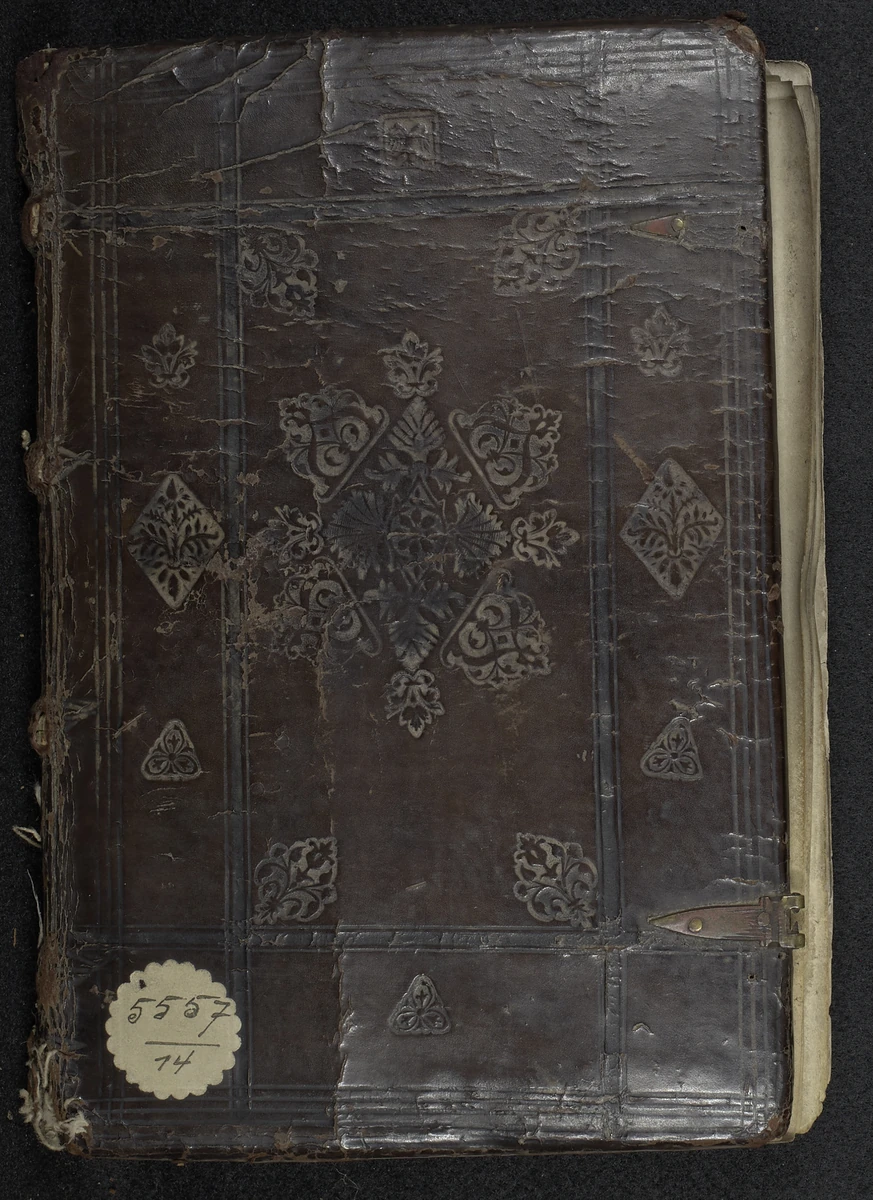
Gold tooling is a way of decorating a book cover by impressing a heated tool through gold leaf onto a prepared surface, commonly leather. The resulting line or motif is not simply gold paint: the tool’s shape, heat, pressure, and the covering material all contribute to the impression. The Victoria and Albert Museum’s account of binder Sarah Prideaux explains the use of heated finishing tools and gold leaf, while Bridwell Library’s survey places the technique in a wider history of European binding.[1][2]
Tooling can range from a small title or rule to a dense pattern across a board. The repeated marks may have been produced with individual hand tools or rolls, but the appearance of a design does not identify the exact tool or binder by itself. A careful description separates what can be seen from what historical sources establish.
From a tool face to a cover impression
A finishing tool has a face that carries a line, letter, or small ornament. When heated and pressed against a prepared cover with gold leaf in place, it can leave a gilt impression. Bridwell Library describes this method as related to blind tooling, with a sheet of gold leaf between the heated tool and leather. Blind tooling creates an impression without gold. The two techniques may appear together on one binding, so note each area separately.[2]
The result depends on controlled contact. Too little or uneven contact may leave a weak impression; too much pressure or heat can damage a cover. These observations explain why the process requires training, not how to practice on an historic book. Tooling on a collection object is not safely recreated by reheating a household implement or pressing a new design into the surface.
Read lines, rolls, and repeated motifs
Look at the geometry of the decoration. A straight rule may define a panel, a small tool may repeat as a border, and a larger stamp can anchor a central motif. A roll can produce a continuous pattern along a line. Repetition may suggest an organized workflow, but it does not prove that the same tool was used throughout; a binder could combine different tools or return to a pattern at different stages.
Oblique light helps distinguish a gold surface from a blind impression and can show shallow relief. Avoid rotating the book repeatedly or touching a decorated area to test whether it is raised. Gold may be worn, tarnished, or missing in places, and the underlying leather may be cracked. A clear image of the entire board plus a close detail provides better evidence than rubbing the design with a cloth.
A European history with a broader context
Bridwell Library’s exhibition states that gold tooling was first used in Islamic bindings and spread from Italy to France during the first quarter of the sixteenth century. It describes gold tooling’s widespread introduction in European bookbinding during that century and notes that decoration often communicated ownership or wealth rather than illustrating the book’s subject. These are historical claims within the exhibition’s account and geographic scope; gold decoration has broader histories that should not be collapsed into one European timeline.[2]
The motif may include arms, initials, geometric patterns, or floral forms. Such marks can be useful evidence about a binding’s intended appearance or a possible owner, but they are not conclusive provenance on their own. Initials may belong to an owner, dedicatee, binder, or later user. Compare them with catalogues, other marks, and documented histories before making an attribution.
Tools record a workshop practice
Sets of finishing tools can reveal repeated design choices and technical capability. In her article on Sarah Prideaux, the V&A discusses a collection of tools associated with her work and explains how heated tools transfer gold impressions. A tool’s presence in a collection may document workshop practice, but the tool alone does not show which specific book it decorated. A match between a tool and a binding should be described only when supported by evidence.[1]
When studying a bound volume, note tool shapes, spacing, and the parts of the cover where the pattern appears. If the same device occurs on multiple copies, compare condition and placement rather than assuming identical production dates. Differences can arise from later restoration, retouching, or a binder’s variation in laying out the design. A catalogue record or conservation report can help separate these possibilities.
Condition and handling
Tooling is often on leather, and the cover can be vulnerable even when the gold is visually striking. Avoid polishing, buffing, or applying leather dressing. Such products can darken the covering, alter the surface, or interfere with future treatment. Keep fingers away from worn gilt lines and support the boards while opening the book. Repeated friction at the joints can abrade decoration where the cover bends.
If a gilt area is flaking, powdering, or detached, do not brush it or apply adhesive. Close the book carefully if that can be done without disturbing the area, place it in a supportive enclosure, and consult a book conservator. Photograph the location before moving the volume. Treatment depends on the gold, leather, adhesives, and condition of the board; a surface that appears simply “dirty” may contain fragile original material.
Document without making an attribution
A useful record includes the visible design, the location on the cover, whether the impression is gilt or blind, and any losses. Include the title page and catalogue identifier so the description remains linked to the correct object. Use terms such as “gold tooling” for a visible gilt impression, but avoid naming a tool, workshop, or maker unless a source supports it.
Lighting affects how much gold appears in a photograph. Record whether the image was taken under direct or raking light, and do not apply filters that change the apparent colour. Keep both overall and detail views. A future researcher can then compare the evidence with another binding or with a tool collection without confusing photographic effect with the object itself.
Why the impression matters
Gold tooling is a technical process and a visual language. It connects a tool’s design to skilled pressure and heat, and it may communicate decoration, identity, or status. Institutional histories help explain how the process developed and how particular binders used tools, while an individual binding carries evidence specific to its own making and treatment.
Read that evidence carefully: distinguish gilt impressions from blind tooling, note the limits of attribution, and avoid testing the surface. The cover can be studied in detail without reenacting the process. For historic books, stable support and conservative handling protect both the leather and the design pressed into it.
Sources
References below support the factual explanations in this article. Read each source within its stated scope and context.