
Tool Bench · FIELD NOTE 44
Fore-Edge Painting: Hidden Pictures at the Edge of a Book
How can a painted scene disappear when a book is closed?
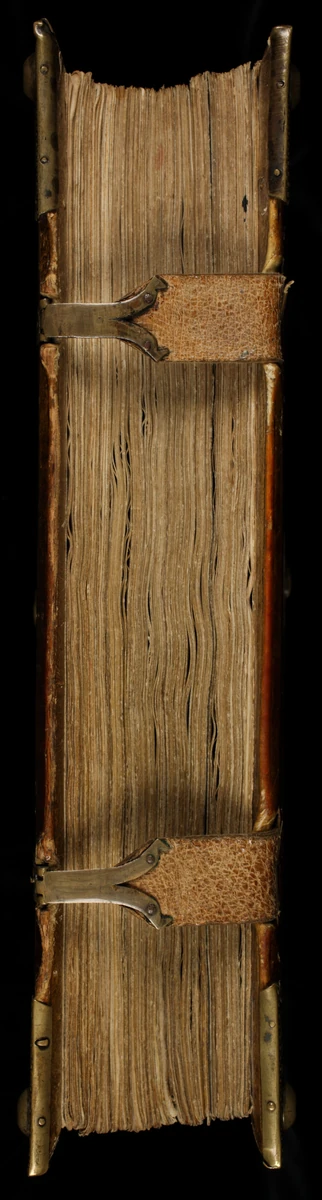
The fore-edge is the outer edge of a book’s pages opposite the spine. It can be gilded, marbled, painted, or left plain. A fore-edge painting is an image placed on that edge. In a hidden or “disappearing” example, the pages are fanned slightly while the image is painted; when the book closes, the picture may be concealed beneath a gilded or decorated edge. The Library of Congress and the Folger Shakespeare Library both document this unusual meeting of book structure and image.[1][2]
Not every painted fore-edge is hidden. The Library of Congress explains that Renaissance artists painted scenes on a visible surface, while the fanned-edge method became a way to conceal an image when the book was closed. The distinction is important: a visible edge painting and a hidden fanned painting may be described using the same broad term but are made and viewed differently.[1]
How fanning changes what can be seen
In a hidden example, the edge surface is exposed by moving the pages into a fan. The painting sits across the angled edges rather than appearing as a normal illustration on a page. Closing the book brings those surfaces back together and disguises most of the image. A painted edge that remains visible when the book is shut follows a different arrangement and should not be called hidden without qualification.
The Folger describes an early nineteenth-century example associated with Edwards of Halifax in which the pages were fanned, clamped, and painted, then gilded so the picture is almost entirely concealed when closed. It also discusses other examples whose images appear under different fanning directions. These are object-specific records, not a universal recipe or a basis for opening every book in the same way.[2]
Dating the painting is not dating the book
A fore-edge painting can be later than the text block or binding. The Folger cautions that a book’s publication date does not establish when its edge image was added; the painting can be no earlier than the book, but it may have been made much later. A date in a catalogue should therefore be attached to the component it describes: edition, binding, painting, or later provenance note.[2]
This distinction is useful when researching a volume that has a decorated edge. Begin with the printed title page and edition record, then locate any catalogue description of the painting. Compare signatures, binding materials, and ownership records only when documented. A scene that appears to fit the text does not prove that the image was commissioned for that edition or made by the bookbinder.
Images and stories on a narrow surface
Fore-edge painters have used landscapes, portraits, and other scenes. The Folger describes a six-volume Shakespeare set with different English landscape views, and also documents paintings that depict theatrical sites or a religious subject. The narrow edge requires a composition that can be read when the leaves are spread. The subject may relate to the author or owner, or it may be chosen for visual effect; each claim needs evidence from the object or a record.[2]
The edge can also carry decoration that is not a painting. Gilding, marbling, labels, and simple colour are part of the book’s finishing. The Library of Congress’s overview places these practices in a long history of decorated fore-edges, with a hidden image as one specific technique. When describing a volume, note exactly what appears closed and what becomes visible only when its pages are fanned.
Why opening it can be risky
To reveal a hidden image, someone must fan the text block. That movement may strain the sewing, folds, spine, or brittle paper. A book that is not known to have a hidden painting should not be fanned experimentally. Even a documented fore-edge may have weakened since its last examination. Follow the holding institution’s instructions and allow staff to position the volume if the image is part of a supervised consultation.
Do not pull leaves apart with a tool, press the spine flat, or hold the book by the page edges. If the book is brittle, distorted, or tightly bound, stop rather than trying to produce the ideal view. A conservator can decide whether the image can be shown safely and what support is needed. A digital surrogate may provide access without repeated movement of the original.
Photographing the hidden edge
When photography is allowed, capture both the closed edge and the image in its supported fanned position. Keep the book on a cradle, use the angle approved by reading-room staff, and avoid placing a camera or light on the pages. Record the direction in which the leaves were fanned, since a double fore-edge painting can reveal different scenes in opposite directions. A caption should say if the image is partly concealed or shown in a special position.
Photographs can make the painting easier to inspect, but they flatten depth and may exaggerate colour under certain lighting. Preserve the original file and note the date, collection, catalogue number, and any handling instructions. Do not crop away the fore-edge context if the image will be used to explain how the technique works. A complete view helps future readers distinguish a page illustration from an edge painting.
Record the object in parts
A careful catalogue note distinguishes the publication date, binding date, edge decoration, and any known painter or binder. It also describes whether the painting is visible when closed, appears under fanning, or is painted directly across the exposed edge. These distinctions make the record searchable and prevent a later reader from treating every decorative edge as the same thing.
Look for supporting evidence such as a signed inscription, a sale catalogue, a provenance note, or an institutional description. The Folger provides a good example of how a specialist can connect an edge painting to a binder, edition, and historical catalogue while still marking uncertainty. Without comparable documentation, describe the image and leave attribution open.
A hidden picture still depends on a book
Fore-edge painting shows that a book’s pages can act as both text support and a viewing mechanism. The image is not separate from the object: its appearance depends on the angle of the fanned leaves and the surface treatment along their edges. That design is remarkable, but it also makes access dependent on careful handling.
Read the edge without treating the book as a novelty to manipulate. Use collection records, distinguish visible from hidden work, and let trained staff guide any opening that reveals the image. In that way the painting can be studied as an artwork and as evidence of the binding’s use, without asking an old text block to move more than it can safely manage.
Sources
References below support the factual explanations in this article. Read each source within its stated scope and context.