
Tool Bench · FIELD NOTE 19
Awls and Sewing Stations: Making Holes With Intention
How do binders plan sewing holes?
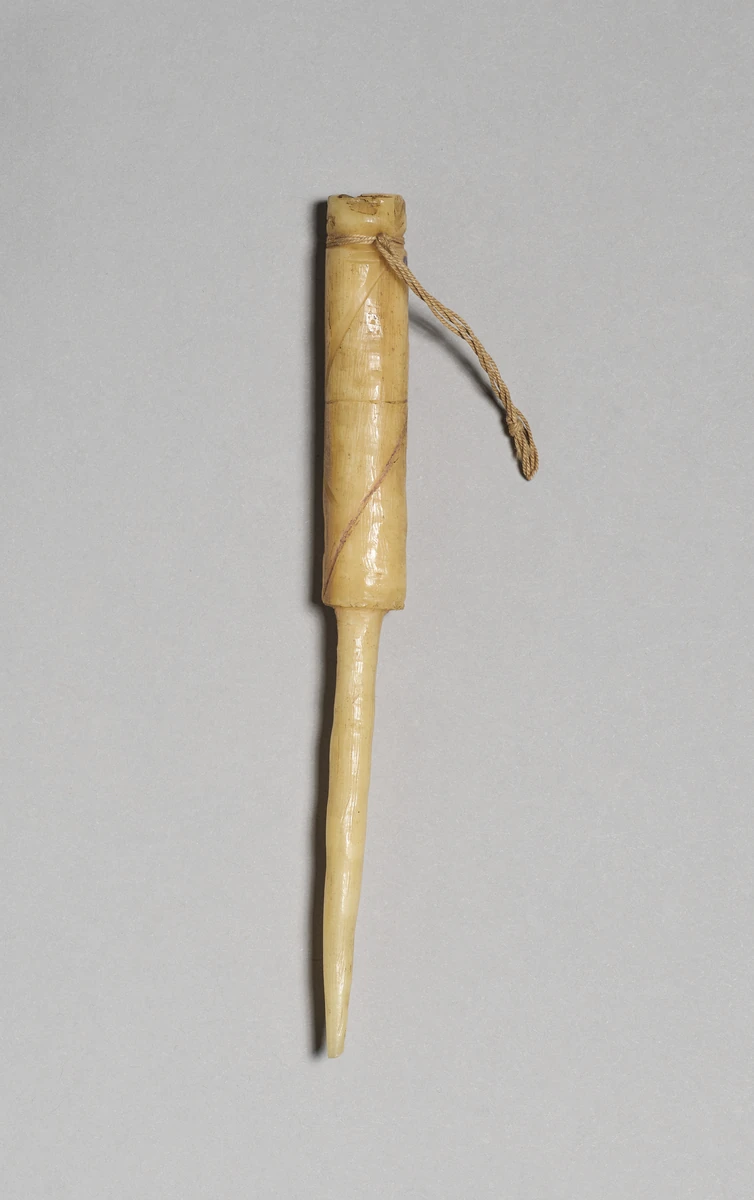
A sewing hole is small, but its position cannot be changed without leaving evidence. In a new handmade book, the awl should follow a planned thread route rather than determine that route by convenience. A well-prepared template, a supported fold, and a manageable stack do more for consistency than a forceful push. The question is not simply how to make holes. It is which openings the structure needs, where they belong, and how to make them without sacrificing the paper around them.
A station is a structural position
Getty's Art and Architecture Thesaurus describes sewing stations as positions where a needle enters or emerges from leaves or gatherings. The term names a working location rather than a particular puncture made by one tool. A hole may be one part of that location. Begin the plan by drawing the intended sewing arrangement, so the positions on the paper correspond to the structure you are actually going to assemble. [1]
The Language of Bindings adds an important refinement: some broad supports use more than one hole at a single station, and unsupported structures still have stations. A diagram containing five holes does not therefore always describe five supports. Keep holes, stations, and supports distinct on the template. This simple naming discipline prevents a maker from copying the visible count while misunderstanding the thread's relationship to the underlying binding. [2]
Establish an orientation before transferring marks
Mark the head, tail, and inside of the template for a new project. A symmetrical-looking pattern can conceal a reversed section when the book is assembled. Add an orientation mark on disposable planning material rather than writing on a historic leaf. Use the same reference edge for each transfer. If the template shifts or curls, correct the setup before piercing; repeatedly adjusting individual holes by eye makes the completed rhythm harder to interpret.
A useful dummy includes the intended section thickness and cover arrangement. A thin sample can make a tool seem suitable while a thicker gathering redirects its point or opens less comfortably. Plan with the actual stock you intend to use, but use expendable sheets. This is a suggested construction rehearsal, not a historical reconstruction or proof that a particular hole spacing is appropriate for every book of the same height.
Support the fold and control the point
An awl is a pointed tool, so arrange the work with a stable support and keep fingers out of its path. Do not hold a gathering against a hand as the backing. Follow a reliable method for the chosen structure and work within the tool's handling instructions. If considerable force is needed, stop and reassess the stack, support, or tool. More force is not an adequate substitute for a clear, controlled route.
The paper removed or displaced at the station affects what remains to resist sewing tension. For a model, compare the intended needle and thread with the hole rather than using the largest available point to make threading easy. A wide, ragged opening may be visually unobtrusive after sewing but still leave less intact paper. Conversely, an opening that forces a needle can be enlarged accidentally during the thread pass. The combination deserves evaluation as a system.
Read mistakes before multiplying them
Pierce one practice gathering and inspect both sides. Check location, direction, and whether the entry and exit belong to the same intended fold. Then rehearse the thread route. A sewing diagram that works on a flat drawing can expose an alignment problem in a folded stack. Discovering this before the rest of the edition is pierced preserves options; discovering it afterward invites compensating knots, enlarged holes, or an unnecessarily distorted layout.
If a new station is misplaced, do not immediately add another beside it. First ask whether the section can be replaced, the design reconsidered, or the visible error accepted on an explicitly expendable learning model. Closely spaced corrections remove the advantage of a carefully planned opening. The cleanest-looking repaired line is not necessarily the soundest decision. A prototype exists to reveal problems early enough that its materials can be replaced without loss of important content.
Existing holes are evidence, not a ready-made pattern
A historic fold can contain holes from different sewing campaigns or other changes. Do not assume that the clearest surviving row describes the original structure. A condition record can locate visible stations and distinguish thread still present from empty openings without assigning a date. Preserve uncertain evidence for examination rather than repiercing it to make a new needle fit. Reuse decisions in conservation depend on more than convenience.
For a beginner's learning sequence, separate the tasks: draw the route, make the oriented template, pierce the dummy, and inspect the sewn result. Record the materials and any change you make between versions. This is more informative than practising several decorative stitch patterns on the same damaged fold, because it lets you identify whether a problem arose from layout, piercing, or tension rather than treating all three as one vague sewing failure.
An awl makes a planned connection possible; it should not replace planning. Clear terminology, consistent orientation, suitable support, and a sample thread pass turn a set of punctures into a coherent sewing system. For old books, the same understanding improves observation while setting a boundary against casual alteration. The smallest opening deserves attention because it is both a mechanical decision and a lasting mark in the paper.
Sources
References below support the factual explanations in this article. Read each source within its stated scope and context.