
Archive Visits · FIELD NOTE 49
Foldout Maps and Plates: How Their Attachments Affect Use and Care
Why do maps and plates need a different opening and support plan?
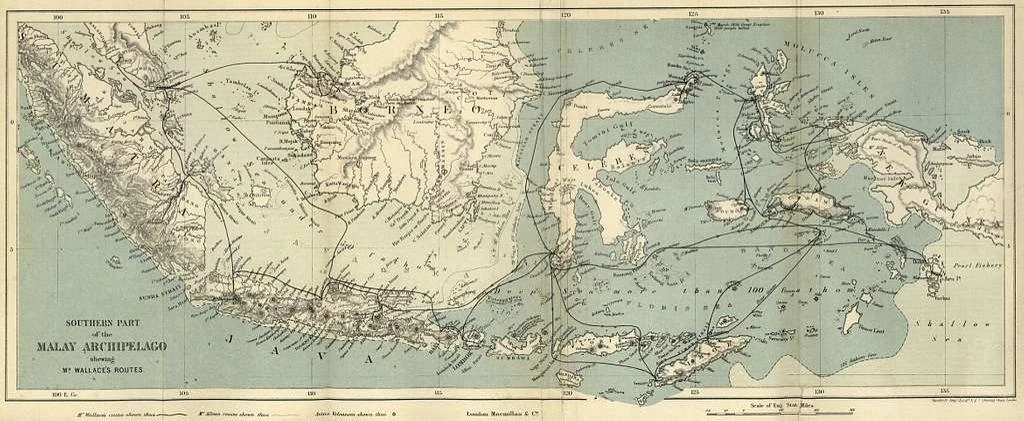
Foldout maps and plates extend beyond the ordinary page size but remain attached to a book. Their folds, guards, and sewing affect how they open and how the surrounding pages bear strain. A foldout is not simply a large sheet tucked into a volume: it is part of a structure that has to move through the binding. The Library of Congress’s atlas-binding workshop documents sixteen different ways maps were placed and attached in a model book, showing how varied these structures can be.[1]
Some foldouts open from the fore-edge, others from the top or another edge, and a map can include more than one fold. The attachment may use a guard, a sewn fold, a tipped edge, or another arrangement. Do not assume a single standard mechanism. The first task is to find where the sheet joins the book and follow its fold sequence without pulling it open.
Trace the folds before unfolding
Look for the outermost edge, the first crease, and any part concealed beneath the neighboring leaf. A foldout may be tucked in a predictable order, but an old repair can change the sequence. If the map is already open, note which panel lies on top and how the sheet returns to the page. A quick sketch or photograph can prevent confusion when it is time to close the volume.
Do not unfold a sheet by pulling at its corners. Support each panel close to its fold and move only as far as the paper responds easily. A fold that resists may be weakened, adhered, or held by a hidden attachment. Stop if there is crackling, a new crease, or tension at the sewn edge. Staff in a reading room can show the intended opening sequence for a collection item.
Attachments influence the pages around them
A large foldout adds material and thickness at a particular point in the text block. The way it is attached can affect neighboring folds and pages. The Library of Congress workshop describes examples where a thick compensation block intended to balance a foldout contributed to torn neighboring pages. That finding underscores why bookbinding methods must be evaluated in context; adding bulk is not automatically a safe way to make a volume close evenly.[1]
Look at the page facing the foldout and at the sewing or guard that holds it. Note tears, detached attachments, and distortions nearby. A tear at the fold may come from repeated opening, while a tear in the adjacent leaf may relate to thickness or a repair. These are possibilities to record, not diagnoses to make from one symptom. A conservator can examine how the attachment transfers force through the binding.
Read the map as both image and structure
Maps and plates often invite a full opening because details may continue across several panels. The image’s layout can reveal the intended reading order, but the sheet’s paper and attachment determine what movement is safe. A map that was designed to unfold may still be too fragile to open fully today. Access needs to account for condition, available support, and the purpose of consultation.
When viewing a map, identify its title, scale, orientation, and panel boundaries without pressing folds flat. Place supports beneath the exposed sections so they do not hang over a table edge. Avoid weights on the image unless staff provides a suitable method. Do not use adhesive tabs or clips to hold a panel open; those can mark the sheet or concentrate pressure on a weak fold.
Support during digitization
The Library of Congress digitization guidance emphasizes supports for bound books and cautions against forcing an opening flat. A foldout may need a wider work surface, a custom support, or a staged capture. The camera setup should not require the book to bear its own weight at a strained angle. If the sheet is oversized, an operator may need to reposition the support between images while preserving alignment.[2]
Digital capture can improve access and reduce repeated handling, but a set of images should preserve the map’s relationship to the book. Include a view of the attachment, the full unfolded sheet when safe, and enough overlap to show how panels connect. Metadata should identify the volume and note if a section could not be opened. Do not imply that a cropped image represents the entire map when folds remain closed.
Documenting damage and repairs
Condition notes should map each tear, split, and detached section to a location in the fold sequence. Use simple terms such as “outer horizontal fold” or “attachment at lower fore-edge” and include a diagram if needed. Photograph both the map and its relationship to neighboring pages. This makes it possible to compare changes without repeatedly unfolding the original.
Older repairs may include guards, patches, hinges, and added strips that alter how the map opens. Record them without assuming when or why they were added. Do not remove a guard or replace an attachment as a test. Conservation treatment may need to preserve evidence of the original arrangement while supporting the sheet for future access.
Storage and closing sequence
Return a foldout using the sequence it naturally follows, with each panel supported as it is folded. Do not press out ridges or force a tight crease. If the map does not close smoothly, stop and ask a conservator or reading-room staff member for help. A map that protrudes from the text block may need an enclosure or a different storage position rather than a stronger tuck.
Store the book in a box that accommodates its dimensions without bending the foldout edge. If the sheet is larger than the volume, a custom enclosure may be appropriate; the design should support both book and map. Avoid placing a heavy object on top of a folded map to keep the book shut. Pressure can deepen creases and stress the attachment.
Why foldout methods vary
The Library of Congress model demonstrates a range of historical and contemporary attachment approaches, from maps on bifolio structures to oversized sheets designed to open flatter. The existence of many approaches reflects differences in page size, map weight, book format, and intended access. There is no single foldout repair that suits every atlas or illustrated book.[1]
That variation is a reason to preserve the individual construction rather than standardize it prematurely. A method that works in a teaching model may not be suitable for a brittle historic volume. Decisions about attachment, compensation, and opening angle should be made by a conservator familiar with the specific object and its intended use.
Access with the structure in mind
Before opening a foldout, know where it is attached, support the book, and follow a documented sequence. If the sheet is resistant, torn, or detached, do not continue simply to see the full image. Ask for staff guidance and consider an existing digital surrogate. The image remains valuable even when the original should stay partly closed.
Foldouts reward careful viewing because they reveal how information and structure were designed together. Their attachment can be as historically significant as the printed map itself. A support, a clear record, and a patient opening sequence let readers consult the image while limiting stress on the paper and binding.
Sources
References below support the factual explanations in this article. Read each source within its stated scope and context.