
Tool Bench · FIELD NOTE 23
Boards and Covers: Stiffness Is Not the Whole Story
How do boards influence a book's durability?
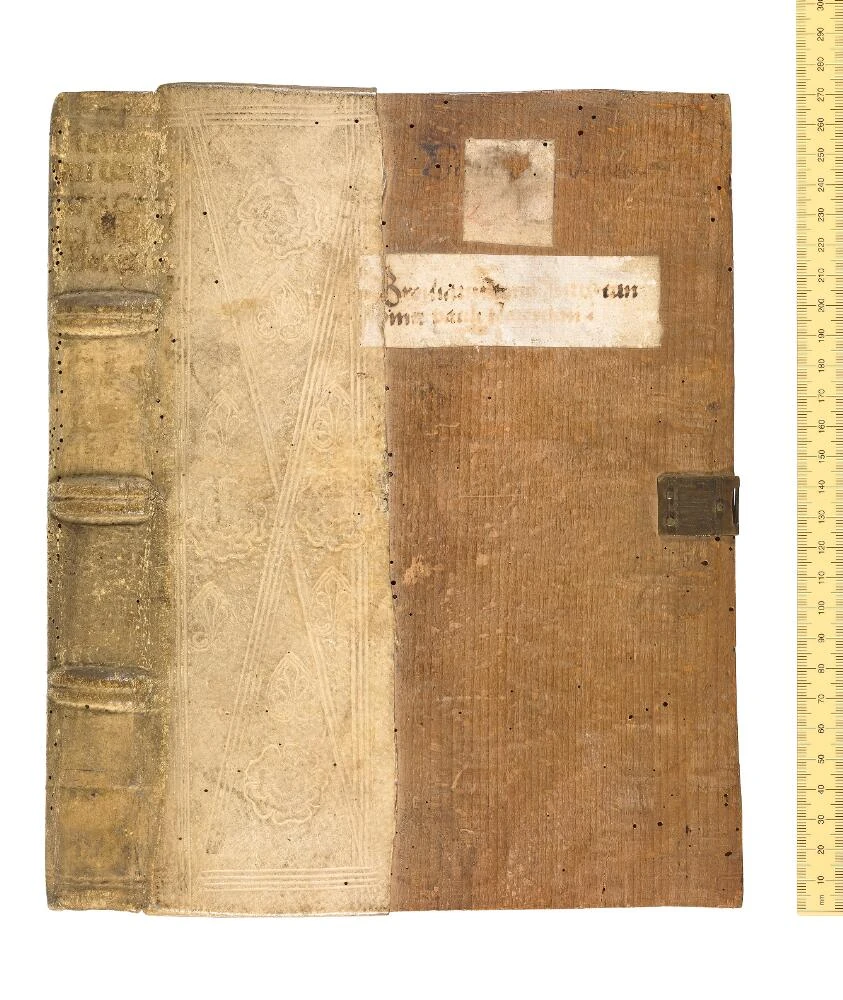
A hard cover protects a book only through its relationship with the pages and their attachment. Increasing board thickness may make the cover feel impressive while making a joint work harder or a small volume awkward to open. Before selecting boards for a new binding or interpreting an old cover, separate stiffness, size, material, and attachment. These properties work together, but none can stand alone as a reliable measure of how well the book will survive its intended use.
What counts as a board
The Language of Bindings defines boards as separate rigid or semi-rigid components that protect and support a book block. Small books can have boards made from comparatively modest sheet material; a continuous wrapper is a different component even if it feels stiff. This distinction helps a description begin with construction rather than appearance. A flexible cover is not necessarily missing its boards, and thick paper is not automatically too slight to qualify as one. [1]
Observe the front and back separately. Do they have comparable dimensions and behavior? Does the covering continue around their edges? Are corners, joints, and the spine area visibly different? These questions establish a map without requiring material identification. Do not scrape an exposed corner or peel a covering back to determine the core. A composite board can contain several layers, and its visible edge may show only one part of its construction.
Thickness is not the same as fit
For a new book, draw the intended page size and place the proposed boards around it in a dummy. Check the projections at head, tail, and fore-edge and the space needed near the spine. A board that protects the edges while closed may still interfere with a comfortable opening. The comparison must include the text block and covering arrangement. Measuring the loose board accurately does not guarantee that the assembled case will fit correctly.
Imagine a pocket notebook with a very heavy cover and thin sections. The cover can dominate its opening even though neither material is defective. Compare that with a large, heavy text block carried by boards that provide little support. These hypothetical examples explain a proportional decision, not a preferred thickness chart. The appropriate balance depends on format, intended use, attachment, and the complete construction method chosen for the project.
Grain belongs on the plan
Dartmouth's repair manual treats paper and board as directional materials and recommends considering matching grain in joined layers. Mark the intended spine direction on the cover plan before cutting the boards and covering sheets. Do not let the longest available rectangle determine orientation by accident. A material-saving layout and a mechanically suitable layout may differ, so compare them while the decision still concerns expendable planning material rather than finished decorated components. [2]
The same caution applies to laminating a new board from several sheets. Choosing layers only by thickness ignores their interaction. Follow a reliable method and evaluate the assembled sample after normal drying. This article does not prescribe a lamination formula or claim a tested resistance to warping. It asks the maker to consider the whole layered construction instead of treating a flat-looking result immediately after pressing as the final assessment.
The joint makes rigidity usable
A board protects by being firm while a joint allows movement. Their partnership is easy to overlook because the large cover surface attracts more attention than the narrow transition. If a board is loose, the relevant problem may be attachment rather than insufficient board strength. If a cover resists opening, adding a stronger hinge material without examining its geometry may simply move the restriction. A visible symptom does not select the replacement component by itself.
The Canadian Conservation Institute's treatment of the Salzinnes Antiphonal documents heavy boards requiring strong but flexible attachment materials and a coordinated reconstruction. The case illustrates how weight and repeated movement must be addressed together. It is not a template for an ordinary hardback: the manuscript's materials, surviving evidence, and treatment goals are specific. Its value here is the clear reasoning that board attachment cannot be specified independently of the boards being attached. [3]
Describe distortion before trying to flatten it
A cupped or warped board invites weight, but its cause and condition may be uncertain. It may reflect material behavior, covering, storage, damage, or several influences. Record the direction and extent of the visible distortion and whether the volume closes without force. Do not push the boards into alignment simply to obtain a neater measurement. Existing resistance is information about the object, not an instruction to apply a heavier stack of books.
For storage, consider how the cover and text are supported in their current condition. A damaged board should not hang from a weak connection while the volume is carried. An appropriate enclosure or temporary access adjustment may reduce movement before treatment is decided. Describe loose fragments and keep them associated with the book. They can retain evidence that a generic replacement board would not reproduce, even if its colour and thickness looked similar.
A well-chosen board belongs to a system: it fits the text, works with the joint, suits the material direction, and supports the intended handling. Those relationships are more informative than a simple preference for stiffness. In making, establish them with a complete dummy. In examination, record them without forcing a result. The strongest-looking cover is only useful when the rest of the book can move and remain secure alongside it.
Sources
References below support the factual explanations in this article. Read each source within its stated scope and context.